
Shapes
Last updated
A Shape layer holds vector shape groups with fills, strokes, and path operations.
Draw a shape
Section titled “Draw a shape”- Deselect all layers.
- Pick a shape or pen tool.
- Draw in the Viewer.
If a layer is selected the tools draw a mask on it.
When using a shape tool while drawing, if you want to maintain the shape’s proportions,
hold Shift while creating the shape.
Fills and strokes
Section titled “Fills and strokes”Each shape group carries its own fill and stroke, set from the toolbar when the shape is drawn. The fill’s colour is editable afterwards from the Timeline, on the group’s own Fill row.
Gradient fills
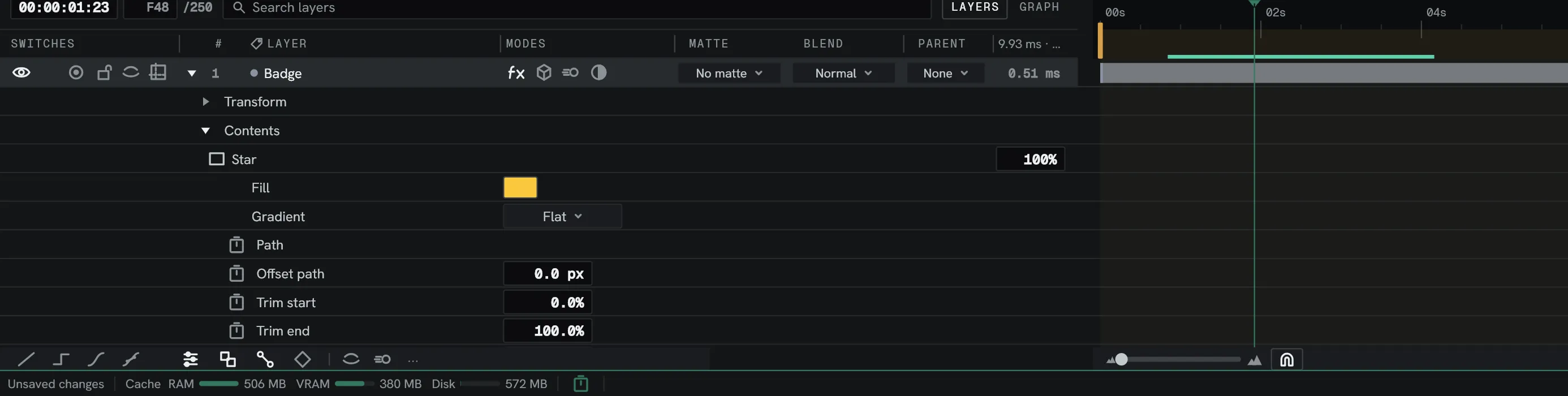
Section titled “Gradient fills”A shape group’s first rows are Fill, the colour inside its path, and Gradient, which is Flat, Linear or Radial. Choose a ramp and three more rows appear: the Gradient colour it ends at, and the two points that aim it.
Linear ramps along the line between the points; radial ramps outwards from the first, with the second on the outer edge. The points are animatable; the two colours are not.
Combine two shapes
Section titled “Combine two shapes”Every shape group after the first in the list carries a Combine row, saying how it joins the one above it: Apart, Union, Subtract, Intersect or Exclude. Apart is the default, and draws it on its own.
A run of shapes all set to something other than Apart folds top to bottom.
The run wears the first item’s paint and modifiers. The ones after it lend their path and nothing else, so their own fill, stroke and dash rows are left off the panel.
A shape fills the same way after a combine as before it.
Animate the shape itself
Section titled “Animate the shape itself”A shape group’s Path row carries the shape, and its stopwatch animates it. Key one path, move the playhead, drag a vertex, and the shape morphs between the two.
Vertices are paired by order, not by feature; where one path has fewer points, it is subdivided to match the denser one first. Whether a path is open or closed is held across the morph.
Trim paths
Section titled “Trim paths”Twirl a shape group open in the Timeline and it carries Trim start, Trim end and Trim offset. Start and end are a percentage of the path’s own length; offset slides that piece along the path in degrees, and 360 is one full lap of a closed shape.
The fill is trimmed with the outline, and an end below the start draws nothing.
Dashed outlines
Section titled “Dashed outlines”A shape with a stroke carries Dash, Gap and Dash offset rows, in pixels. Dash is the length of each mark, Gap the space after it, and the pair repeats along the path. Both start at zero — a solid outline. Key the offset and the dashes move along the path.
Offset paths
Section titled “Offset paths”The first row under a shape group is Offset path, one number in pixels. Positive pushes the outline outwards; negative pulls it in. Corners come out round.
Pull the outline in by more than the shape is thick somewhere and it can cross itself, leaving a small loop.
The repeater
Section titled “The repeater”Every shape group carries a Copies row. Turn it above one and the group is drawn that many times, each copy one more step along than the last, and nine more rows appear to describe the step: Repeater position x and y, Repeater rotation, Repeater scale, the Repeater anchor the turn and the scale happen about, and Start opacity and End opacity, which the copies fade evenly between.
Copy offset says which copy the original art is, so a negative number puts copies behind it. A copy is a scaled drawing, not a scaled path — halve the scale and the outline and the dashes halve with it.
The layer’s box grows to hold the copies, and the layer’s position stays pinned to that box’s corner. The count stops at 100 copies.