
Compositions
Last updated
A composition is a timeline with a fixed resolution, frame rate, and duration. It holds an ordered stack of layers.
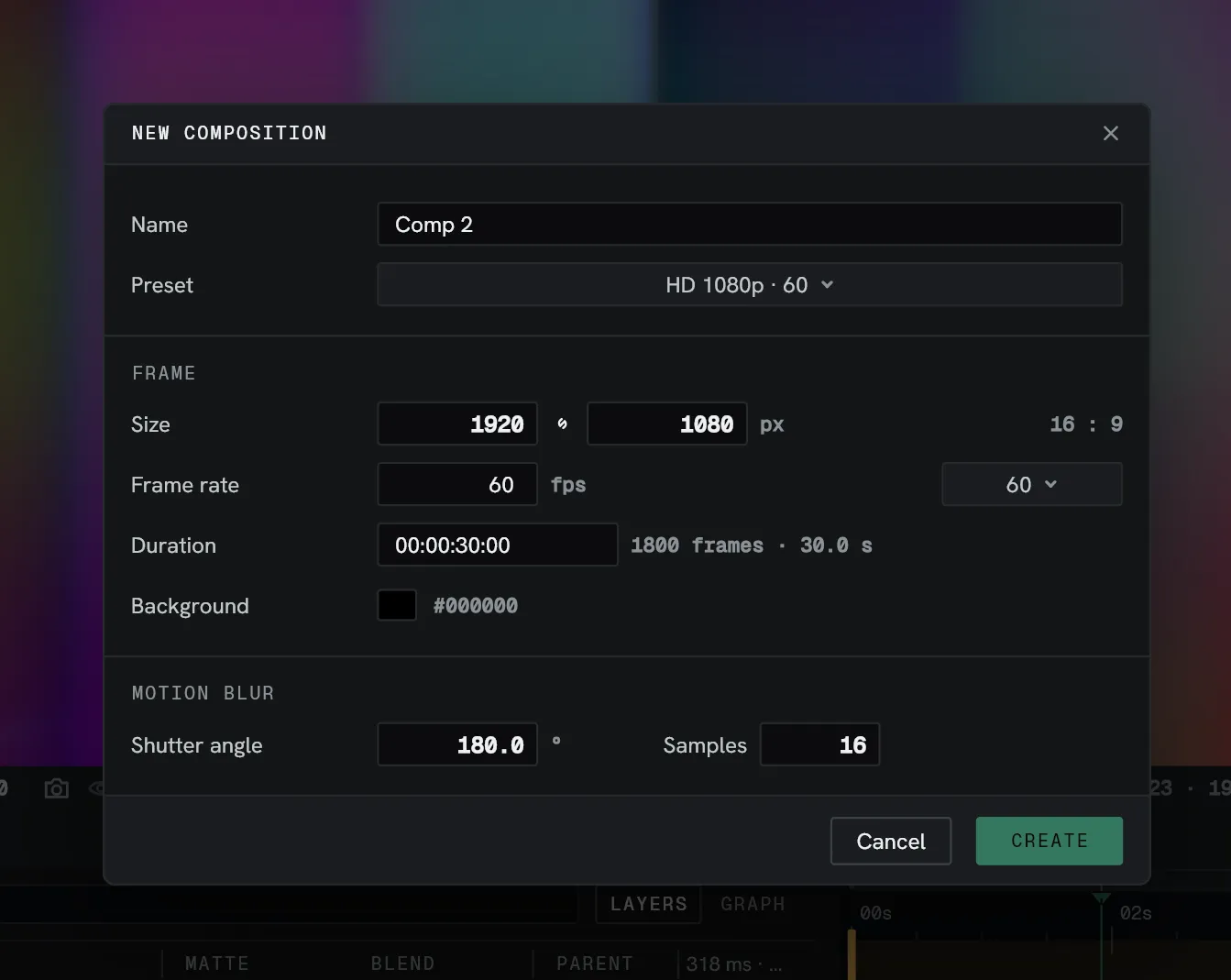
One project can have multiple compositions. A composition is an asset, so it sits in the Project panel.
Make a composition
Section titled “Make a composition”- Choose Composition ▸ New composition.
- Set the resolution, frame rate, and duration.
- Confirm.
Change the settings
Section titled “Change the settings”Choose Composition ▸ Composition settings. Any of these settings can be changed at any time. Additionally, right-clicking a composition in the Timeline or Project panel brings up a popup menu with the composition settings as an option.
Changing the frame rate does not move your layers or keyframes. If they no longer line up with composition frames and snapping is enabled, the next time you move them they will align with the new frame rate.
Nest one composition in another
Section titled “Nest one composition in another”A composition used as a layer inside another is a Precomp layer. The verb is precompose.
Precompose when you want to:
- Treat a group of layers as one object.
- Apply one effect to several layers at once.
- Retime a whole group of layers together.
Select the layers and choose Layer ▸ Precompose. The shortcut by default is Ctrl+Shift+C.
A Precomp layer supports Retime, so the speed of a nested composition can be ramped.
A composition holds a layer stack or a node graph, never both. Composition ▸ New node graph makes the second kind. It nests the same way: as a Precomp layer in another composition, and as a Read box in another node graph.
Lumit refuses to place a composition inside itself.