
The node graph
Last updated
The Node graph draws the selected layer’s effect stack as boxes joined left to right by wires. It is the same stack the Effect Controls panel lists, with the ability to wire a driver into parameters.
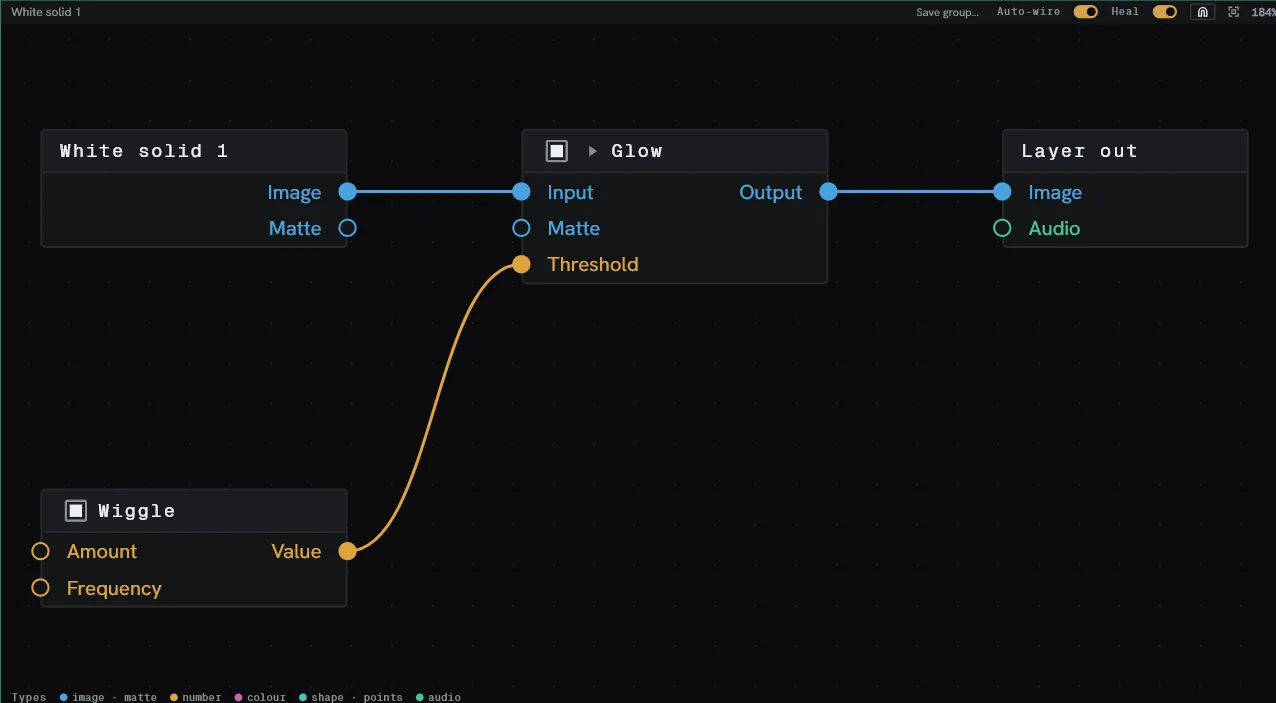
Open it from Window ▸ Node graph, or switch to the Nodes workspace. The panel follows the layer selected in the Timeline.
The image chain
Section titled “The image chain”Every graph starts with Source, one box per effect in order, and Layer out.
| Gesture | What it does |
|---|---|
| Drop a node onto a wire | Inserts it at that point in the stack. |
| Drag a box’s body | Moves it. A drag that starts inside the selection moves the whole selection. |
| Drag from a socket | Pulls out a wire; drop it on a socket that takes the same kind of value. |
| Drag a wire off an effect’s input | Bypasses that effect. The picture goes past it and it keeps its place in the stack. |
| Drop a wire back on it | Switches it back on, and moves it to where the wire says. |
| Drag the wire off Layer out | The layer draws nothing until something is plugged back in. |
Delete | Removes the picked boxes. |
Two switches sit in the panel’s toolbar. Auto-wire joins a dropped node to the wire in hand as it lands. Heal reconnects the neighbours of a deleted box.
Getting about the canvas
Section titled “Getting about the canvas”- Middle-drag pans. The wheel zooms about the pointer.
- Frame all fits every box on screen.
- A primary drag on empty canvas sweeps a selection box. Click replaces the selection,
Ctrl-click toggles one,Shift-click adds, andCtrl+Aselects everything. - Dragging an effect from Effects & presets onto the canvas adds it: an effect joins the stack, a driver lands where it is let go.
- A right-click on empty canvas, or
TaborShift+Awith the canvas focused, opens the node search at the pointer, asctrl+spacedoes. Each of the three can be turned off in Settings ▸ Timeline. ctrl+spaceopens the node search. With a wire in hand the results are filtered to the kinds that wire can join, and picking one connects it.
Each box carries two small badges. The checkbox enables or disables a specific node and the picture passes through untouched. The twirl opens the node, displaying a socket for every parameter. In a node graph an open node also carries the parameters’ controls.
The checkbox and the wires say the same thing. A bypassed effect is drawn unwired — hollow sockets, and the chain running from the box before it to the box after — so switching one off in Effect controls unplugs it here, and unplugging it here switches it off there.
Drivers
Section titled “Drivers”A driver makes a value rather than a picture, and a wire from a driver into a parameter’s socket makes that parameter follow the value.
| Driver | Hands out |
|---|---|
| Wiggle | A random continuous number changing by an Amount at a Frequency. |
| Audio level | The loudness of a named layer’s sound at this moment. |
| Colour cycle | A colour whose hue turns at a Rate. |
| Math | Two numbers and an operation. |
| Remap | Maps a number from one range onto another, with a clamp. |
| Smooth | Its input, softened over Time. |
| Points sample | Reads a points stream: how many points are alive, and how far the nearest one is from a position. |
| Layer points | Another layer’s points, brought into this graph. |
Add one from the effect console “ctrl+space”, they are grouped under Drivers — and wire its output to
a parameter’s socket.
Wires don’t cross between layers. The two drivers that read another layer name it instead: Audio level has an Audio row and Layer points a Points layer row, both ordinary layer pickers.
A driven parameter’s row in Effect Controls names the driver in place of a value. Its keyframes are overridden while the wire is there, and come back when it is pulled.
Wires and their colours
Section titled “Wires and their colours”A wire’s colour is the type of value it carries:
- image · matte
- number
- colour
- shape · points
- audio
A wire dropped on a socket of another kind is refused.
Mattes and points
Section titled “Mattes and points”An effect’s Matte socket takes a wire as well as the layer picker on its row.
Particulate and the rest of the points family have a socket of their own, for another box to read the point stream.
Seeing the picture at a box
Section titled “Seeing the picture at a box”Selecting exactly one effect — a box here, or a heading in Effect Controls — puts an at <effect> chip over the Viewer’s picture. Turn it on and the Viewer renders the composition with that layer’s stack stopping there.
The Nodes workspace
Section titled “The Nodes workspace”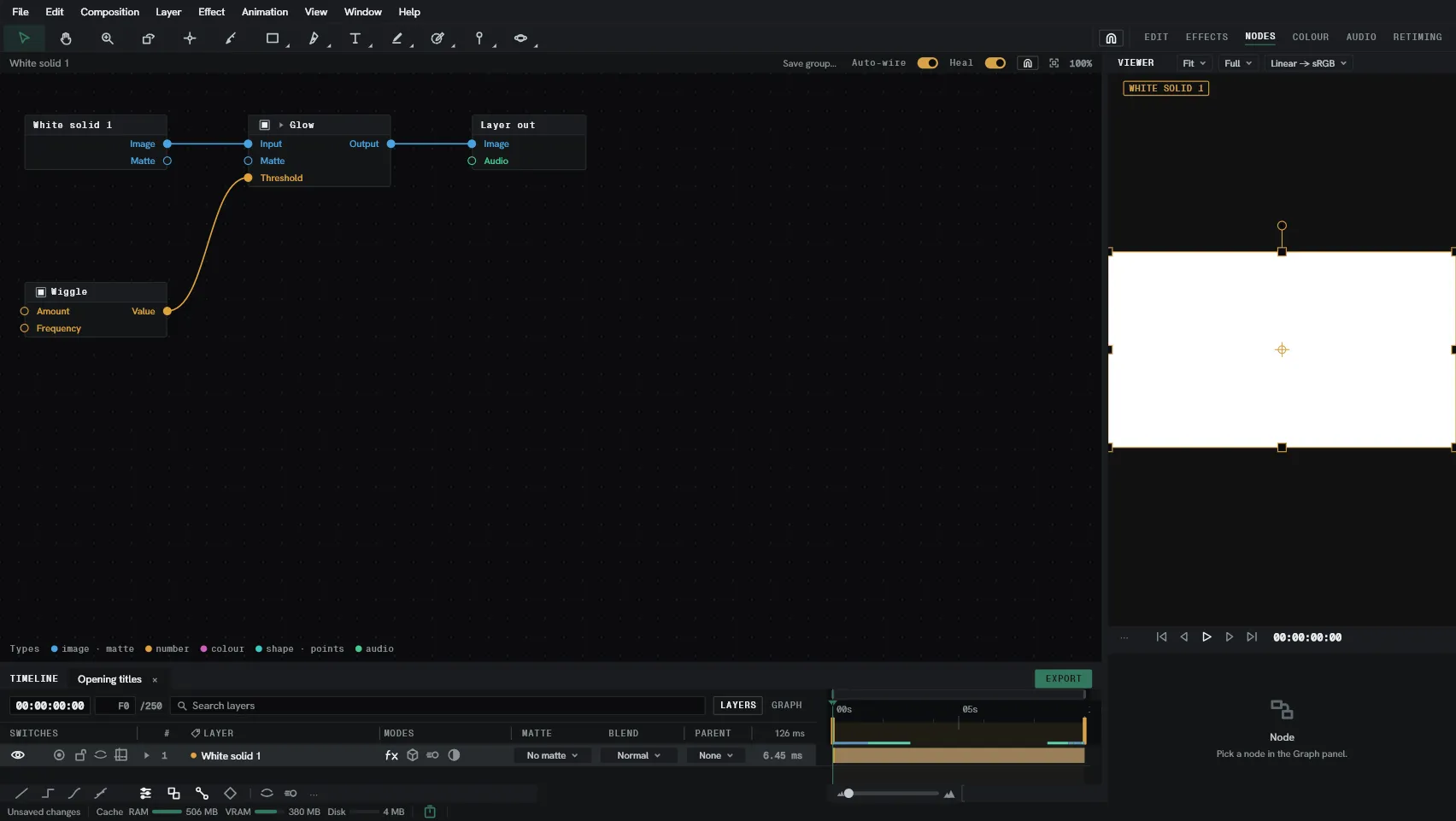
The Nodes workspace puts the node graph in the centre of your view, to allow for work dedicated to nodes. It also keeps the timeline visible to change the selected layer or the current frame. As well as the viewer to the right and the Node panel, which lists the picked box’s parameter rows.