
Viewer
Last updated
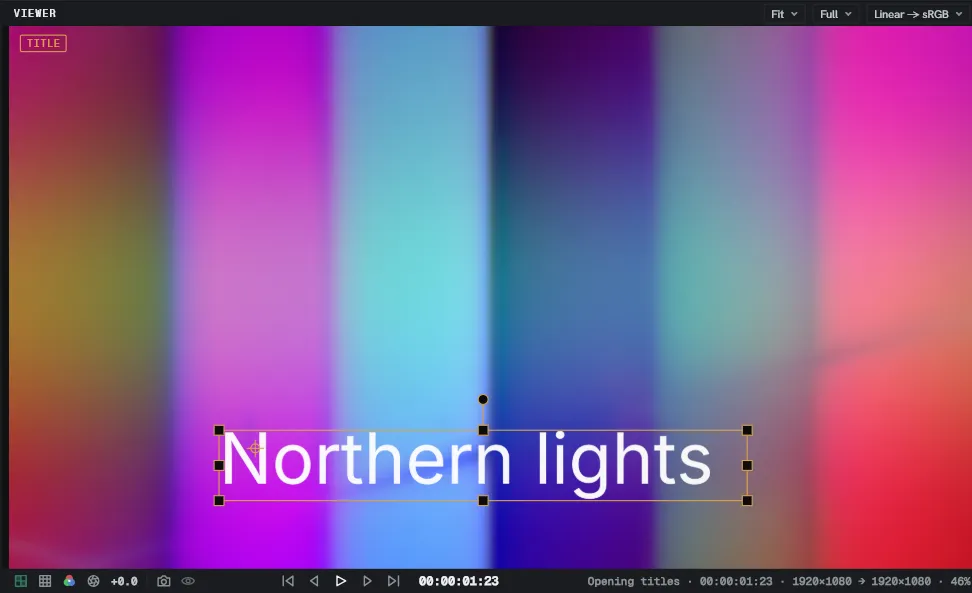
The Viewer shows the composition at the playhead. It has a strip above the picture and a strip below it, and nothing on either of them changes what an export writes.
The strip above
Section titled “The strip above”The panel’s name sits at the left. Three pickers sit at the right.
| Picker | Sets |
|---|---|
| Magnification | How big the picture is drawn. Fit, or a fixed step from 25% to 400%. The wheel zooms too, anchored on the pointer. |
| Preview quality | The preview resolution — full, half, third, quarter or auto — and the playback behaviour, every frame or adaptive. |
| Colour pipeline | The display transform the picture is shown through. Where the project loads a colour configuration it grows a section per display, each of its views a row. |
The strip below
Section titled “The strip below”
| Control | Does |
|---|---|
| Transparency board | Draws a chequerboard behind alpha. |
| Guides | One menu for everything drawn over the picture: the grid, title and action safe, layer controls, the region of interest, and the composition background. |
| Channel | RGB, red, green, blue, or alpha. |
| Exposure | Drag the number; click the mark to go back to zero. |
| Take snapshot | Photographs the picture. |
| Show snapshot | Puts the photograph back over the live picture while it is held. |
| Transport | First frame, previous frame, play or pause, next frame, last frame. |
| Clock | The playhead’s time. Click it to type one; a time past either end clamps. |
| Reading | The composition, the time, the source size, the size the preview was made at, and the magnification. |
The snapshot photographs what is on screen, at the resolution it is drawn at. Holding Show puts it back over exactly the part of the picture it came from.
When the Viewer is narrow
Section titled “When the Viewer is narrow”A Viewer docked into a sidebar has less width than the bar wants, so pieces leave in order — the reading, the ways of looking, the clock — and the five transport buttons are the last items remaining.
The two strips can also be gathered into one, at the top or at the bottom, under Edit ▸ Settings ▸ Appearance ▸ Viewer.
In the picture
Section titled “In the picture”Select a layer and the Viewer draws its wireframe with a transform gizmo. The handles move, scale and rotate it. See Transforming layers. The tag at the top left names what is selected.
Moving about
Section titled “Moving about”- The wheel zooms, anchored on the pointer.
- A middle-button drag pans the picture, whatever tool is armed.
- The Hand tool pans on an ordinary drag.
A middle-button drag does not pan while a dropper is armed.
At an effect
Section titled “At an effect”Select one effect — its heading in Effect controls, or its box in the node graph — and a chip appears at the top right saying at that effect’s name. Click it and the Viewer shows the composition with that layer’s effect stack stopping there. Click it again for the finished picture.
The chip names a box in a node graph composition the same way, and shows the composition with its Output wired to that box.
The dropper
Section titled “The dropper”Some parameters are picked off the picture rather than typed — a colour, or a point. Arm the dropper from the parameter and a magnifier follows the pointer, with an outline round the pixels that will be sampled.
- Shift+scroll grows the sampled region — one pixel, then 3×3 up to 9×9.
- The pick is a drag. The value is previewed as you sweep; the release commits it, as
one undo step.
Escputs back what the drag started from.