
Settings
Last updated
Open the settings window from Edit ▸ Settings….
General
Section titled “General”Language, which follows the system unless you choose otherwise. Whether the welcome screen appears on launch. And Reset workspace, which puts the arrangement you are on back to how it shipped.
Beneath those, whether Lumit checks for updates, and what it found last time it checked.
Appearance
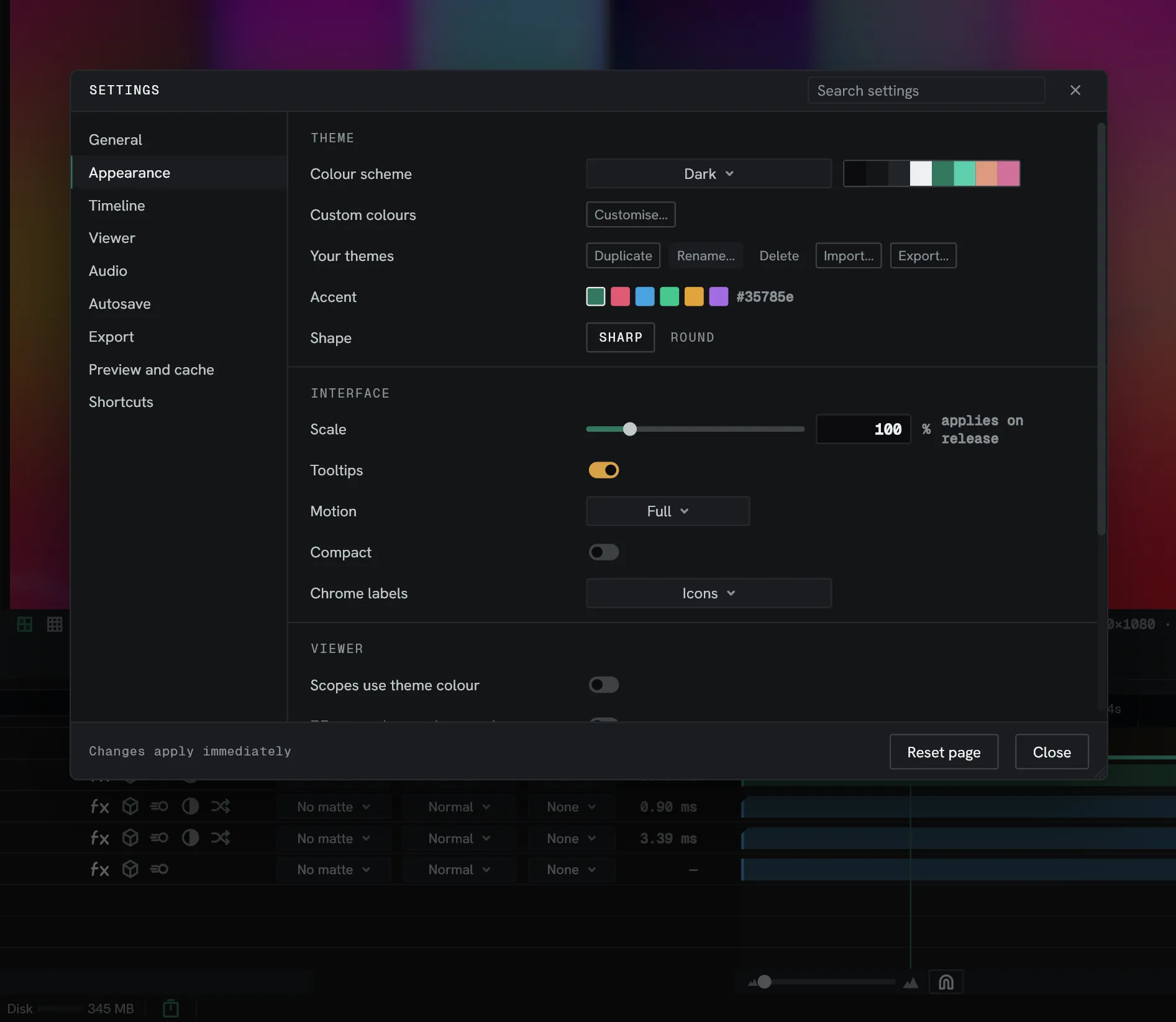
Section titled “Appearance”- Theme: seven built-in schemes grouped dark and light, plus your own. Customise… opens the theme editor; themes can be exported and imported. Accent and Shape tune whichever scheme is in force.
- Interface: Scale, 75 % to 200 %. Tooltips, on or off. Motion, for how much controls animate. Compact, which tightens the row spacing throughout. And labels, deciding whether the bars carry words, icons, or icons everywhere.
- Viewer: whether the scopes and an effect’s own graphs take the theme’s colours or their own, and whether the surround behind the picture is neutral or themed.
Timeline
Section titled “Timeline”Whether Retime opens to the Value or the Speed lens and whether it reads in seconds, whether video is placed in a Sequence layer automatically, whether pasted layers keep their original time rather than pasting at the playhead, and whether the playhead stays where playback stopped.
Then the panel habits: whether Transform appears in Effect controls, whether an ease opens in a popup or the Easing panel, and whether layer names are drawn on the lane bars.
Last, Node graphs: whether a right-click, Tab or Shift+A on a node graph canvas opens
node search. Each is on by default and can be turned off on its own.
Viewer
Section titled “Viewer”Whether the picture is smoothed when zoomed in, and whether the tone-map button appears on the Viewer bar, which can be used to try and help see details in area’s of brightness greater than one.
The output device. Follows the system unless you name one.
Autosave
Section titled “Autosave”How often a spare copy is written, and how many are kept. Setting the interval to nothing turns autosave off.
Export
Section titled “Export”What the export dialogue opens on: a preset, a filename template, and whether it asks for a destination each time or uses a folder you name.
Preview and cache
Section titled “Preview and cache”- Playback: every frame, or adaptive resolution.
- Cache budgets for all three tiers: rendered frames in memory, preview frames on the graphics card, and frames parked on disk. The disk cache’s location is set here too, per machine or per project.
Shortcuts
Section titled “Shortcuts”Every command and its shortcut. Rebind by clicking one; conflicts are flagged. Keymaps export and import.